Case Study:
Impressive Interviewing: A Workshop for Emerging Tech Professionals
Background
Code Louisville students arrived at the end of their technical curriculum having done something genuinely hard: they had learned to code from scratch, most while working, raising families, and navigating the everyday weight of underemployment. They had résumés. They had LinkedIn profiles. They had skills.
What they didn't have was any experience with the peculiar, high-stakes ritual of the technical interview: a process that bears almost no resemblance to the job interviews most of them had navigated before. Getting a job as a junior software developer means surviving behavioral questions, whiteboard coding challenges, panel pop quizzes, and strategic small talk, often in the same ninety minutes. That's a very specific kind of preparation, and it doesn't happen by accident.
Impressive Interviewing was one module in a week-long job search workshop series I designed and facilitated for Code Louisville, a sequence that also covered résumé rewrites with transferable skills, LinkedIn optimization, and in-person networking for a predominantly introverted audience. Each workshop was built to meet students exactly where they were: adults with real-world experience who needed to learn a new language for talking about what they already knew.
Identifying the Need
The need was hiding in plain sight. These students had collectively been on hundreds of job interviews. But when I asked how many had ever faced a technical interview (whiteboard, code challenge, rapid-fire questions from a panel) almost no hands went up.
The gap wasn't confidence. It wasn't work ethic. It was unfamiliarity with a format designed, intentionally or not, to favor people who had been preparing for it their whole lives. My job was to close that gap in a single session, and to do it in a way that felt empowering rather than overwhelming.
Three clear learning objectives anchored everything that followed. By the end of the workshop, learners would be able to:
Apply the STAR storytelling framework to structure compelling, specific answers to behavioral interview questions
Demonstrate composure and problem-solving process during whiteboard and technical challenges, including how to handle not knowing the answer
Engage strategically with interviewers by asking questions that signal research, curiosity, and cultural fit
Design & Delivery
The session was organized into three sections, each following the same rhythm: Lesson, Apply, Review. That structure wasn't arbitrary. For adult learners who had been out of a formal classroom for years, the predictability of the format reduced cognitive load and made practice feel less like a test and more like a workout.
Section One: Method to the Madness
Most behavioral interview questions (the ones that start with "Tell me about a time when...") are really just asking for a story. The STAR method (Situation, Task, Action, Result) gives that story a shape. I walked learners through the framework, connected it explicitly to the accomplishment bullets they had already written on their résumés, and then let them practice on each other. Ten minutes of peer role-play, real questions, real answers. The debrief surfaced what was working and what needed tightening. It gave quieter students permission to hear their own voices saying things that sounded, to their own surprise, pretty good.
One of the trickier teaching moments in this section was the "greatest weakness" question — a classic trap. Rather than coaching students to dodge it, I taught them to use STAR to answer it honestly: describe a real weakness, walk through a situation where it showed up, and land on what you learned and what you changed. That kind of self-aware, structured answer signals exactly what hiring managers are looking for, and it happens to be the truth.
Section Two: Taming the Whiteboard
This was the section that made people nervous. Whiteboarding (writing code with a dry-erase marker in front of an audience while someone evaluates your thought process in real time) is an experience unlike anything in a developer's day-to-day work. It feels performative because it is. And for students who were already navigating imposter syndrome, it could feel paralyzing.
My approach was to reframe it before we practiced it. I started by telling students something that genuinely surprised them: interviewers aren't expecting perfection. They're looking to see where your knowledge tops out. And a good developer who says "I don't know, but here's how I'd find out" is more valuable than someone who freezes or bluffs. I've spoken with hiring managers who won't hire a candidate who never says "I don't know." That one reframe visibly shifted the energy in the room.
Then came the moment every student remembered: no exceptions at the whiteboard.
Every learner grabbed a marker. Every learner attempted FizzBuzz (a classic coding challenge) in front of the class. Some were smooth. Some were shaky. Some wrote pseudocode. Some picked a language they were most comfortable in and just started. The point wasn't the solution. The point was showing the work, narrating the process, and surviving the discomfort of being watched while you thought.
Afterward, I shared a curated set of practice resources (coding challenge sites, common whiteboard prompts, self-quiz tools) and encouraged everyone to keep practicing before their real interviews.
One student took that challenge to heart in a way I'll never forget. Christina went home, set up a little practice station, and started working through whiteboard questions — with her pets as her audience. She talked through her code out loud to her dog and cat, answering their (extremely patient) questions until her stumbling became fluent and her fluency became confidence. Weeks later, she walked into a real technical interview and walked out with an offer. The whiteboard, she said, wasn't the scary part anymore. She'd already done it in front of tougher critics.
Section Three: Make the Connection
The final section was about fit, theirs and the employer's. I walked through what an interview looks like from the inside: how a candidate makes an impression before they say a single word, how to deliver a confident elevator pitch when asked "Tell me about yourself," and how to ask questions that signal genuine research and curiosity rather than nerves. We spent time on the strategic power of the thank-you note (an underused tool that gives candidates one more chance to close the gaps and reinforce their case).
Students left with a list of strong questions to keep in their back pocket, a framework for ending every interview on a high note, and the knowledge that a first interview is, at its core, a first date: the goal is to find out whether you actually want this relationship, not just whether they want you.
Outcomes
Across multiple Code Louisville cohorts, Impressive Interviewing became one of the most referenced sessions students cited when they landed jobs. The combination of practical frameworks, peer practice, and the shared vulnerability of the whiteboard exercise created the kind of learning that travels into real interviews, real negotiations, and real careers.
Christina's pets-as-audience approach became something of a legend in the program. But it wasn't accidental. It was what happens when a learner internalizes not just the content, but the why behind it: practice isn't about being perfect. It's about building enough reps that the fear gets smaller than the preparation.
That's what good instructional design is supposed to do.
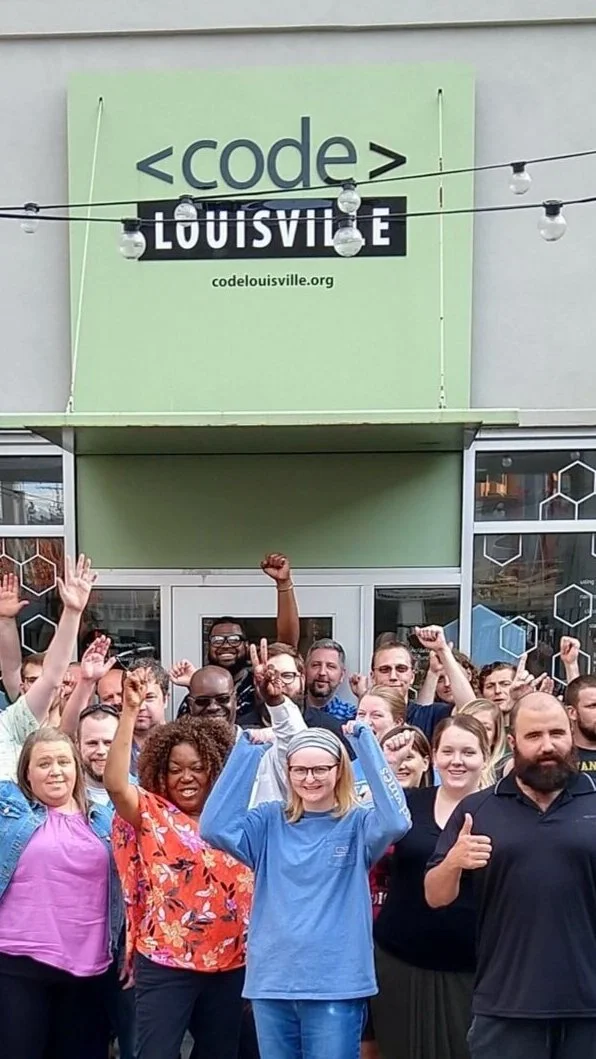
Program: Code Louisville | Organization: Treehouse | Format: Live Facilitated Workshop | Year: 2015
Mistakes will happen. The interviewers are attempting to see where your knowledge tops out, so the expectation is that you will not get every answer correct.
That changes your perception, doesn’t it? Missing a question is not a failure, it will happen so anticipate it and don’t let it derail you. There is so much to know, that nobody knows it all.
But, just like in Math class, it helps to show your work.